
Blue Card in Indoor Soccer: Complete Rules Guide
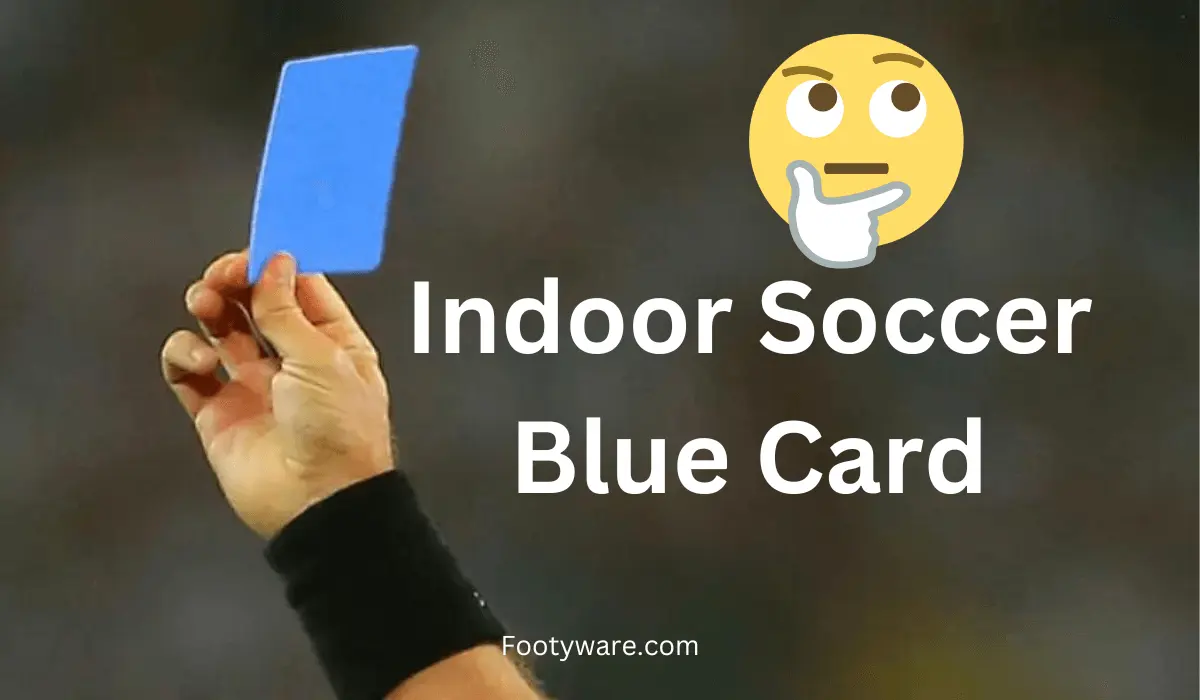
Quick Answer: A blue card in indoor soccer is a disciplinary penalty for minor offenses resulting in a 2-minute time penalty where the offending player sits in the penalty box while their team plays short-handed. Unlike yellow cards (cautions) or red cards (ejections), blue cards create a temporary power play advantage for the opposing team, similar to hockey penalties.
Traditionally, soccer and its types, like indoor soccer and futsal, have been governed by a system of rules and regulations with the help of yellow and red cards. However, the introduction of the blue card adds a new dimension to the spectrum of penalties, focusing specifically on some minor gestures leading to serious offenses while maintaining a fair balance between player safety and game flow.
| Section | Description |
|---|---|
| What is the Blue Card in Indoor Soccer? | An indoor Soccer blue card is being used for minor misconduct and offenses. It’s just a light warning. Unlike the red card in which you’re sent out of the field for the whole game in both indoor and outdoor soccer. |
| Offenses that Warrant a Blue Card | As a referee, I often encounter a range of offenses that can result in a blue card being issued in indoor soccer. These infractions include spitting on the indoor turf, persistent infringement, expressing dissent through words or actions, encroachment, illegal substitution, violations of house safety rules, and minor physical fouls. |
| Blue Card and Timed Penalties | Understanding the duration of penalty timeouts for blue cards, yellow cards, and red cards |
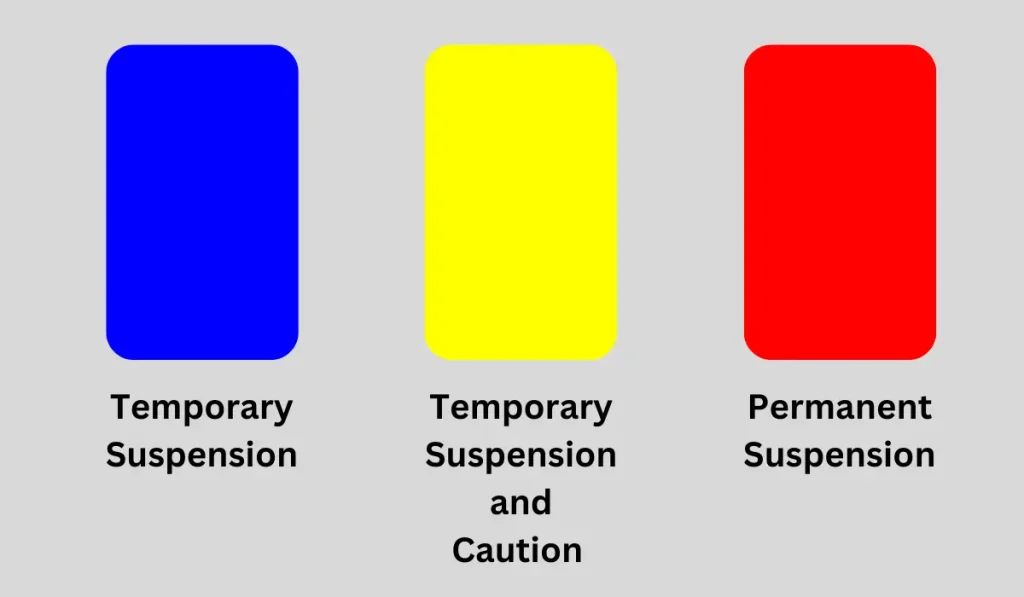
| Differentiating Blue Cards from Yellow and Red | Exploring the distinctions between blue, yellow, and red cards |
| Consequences of Receiving a Blue Card | Highlighting the impact of a blue card on the offending player and their team |
| Blue Cards in Indoor Soccer vs. Outdoor Soccer | Comparing the use of blue cards in indoor soccer to yellow and red cards in outdoor soccer |
| Conclusion: Understanding Indoor Soccer Blue Card | Summarizing the importance of comprehending and adhering to blue card rules |
What is the Blue Card in Indoor Soccer?
The blue card is a unique disciplinary tool used in indoor soccer to penalize minor misconduct without ejecting players from the game. When a referee issues a blue card, the offending player must leave the field immediately and sit in a designated penalty box for 2 minutes (or until the opposing team scores a goal, whichever comes first).
Blue Card Origins and History
Development:
- Introduced in indoor soccer leagues in the 1980s-1990s
- Borrowed from hockey’s penalty box concept
- Designed specifically for indoor soccer’s unique environment
- Not recognized by FIFA or used in outdoor soccer
- Varies by league (some use, some don’t)
Current Use:
- Major Arena Soccer League (MASL) – Uses blue cards
- United Soccer League (USL) indoor divisions – Uses blue cards
- Many recreational indoor leagues – Varies by facility
- Youth indoor soccer – Often uses simplified version
- Professional arena soccer worldwide – Common
Important Note: Blue cards are NOT used in futsal. Futsal follows FIFA rules with only yellow and red cards.
How the Blue Card System Works
The 2-Minute Penalty
Basic Mechanics:
- Referee shows blue card to offending player
- Player immediately leaves field
- Player sits in penalty box (designated area)
- Team plays with one fewer player (power play for opponent)
- Penalty ends after 2 minutes OR when opponent scores
- Player returns to field after penalty expires
Key Rule: If the opposing team scores during the 2-minute penalty, the penalized player can return immediately. This “goal releases player” rule keeps games competitive and fast-paced.
Penalty Box Procedures
Where Players Serve Penalties:
- Designated penalty box area (usually team bench area)
- Separated from active bench players
- Clear sight line to field
- Supervised by officials or timekeeper
Player Responsibilities:
- Must report immediately when shown blue card
- Cannot argue or delay (risks additional penalty)
- Must remain seated during entire penalty
- Cannot coach or communicate with teammates
- Returns only when signaled by referee or timekeeper
Team Impact:
- Must play short-handed (5v5 becomes 4v5 in 6v6 format)
- Cannot substitute for penalized player
- Opponent has numerical advantage
- Creates power play opportunity
Common Offenses That Result in Blue Cards
Blue cards are issued for minor misconduct and technical violations that disrupt play but don’t warrant ejection.
1. Illegal Substitution
Violations:
- Too many players on field
- Substituting outside designated substitution zone
- Entering field before teammate exits
- Substituting during live play (when not allowed)
- Goalkeeper leaving without notification
Why It’s Penalized: Gaining unfair numerical advantage violates competitive balance.
2. Delay of Game
Violations:
- Deliberately wasting time
- Slow to restart play after referee signal
- Kicking ball away after whistle
- Taking excessive time on restarts
- Goalkeeper holding ball beyond allowed time
Why It’s Penalized: Disrupts game flow and wastes playing time.
3. Dissent by Word or Action
Violations:
- Arguing with referee decisions
- Sarcastic comments or gestures
- Excessive complaining
- Questioning referee’s competence
- Disrespectful body language
Why It’s Penalized: Undermines referee authority and sets poor example.
4. Unsporting Behavior (Minor)
Violations:
- Faking injury to waste time
- Taunting opponents
- Excessive celebration
- Minor verbal abuse (not severe enough for yellow/red)
- Attempting to deceive referee
Why It’s Penalized: Maintains sportsmanship and fair play culture.
5. Encroachment
Violations:
- Standing too close during opponent’s restart
- Not respecting required distance from ball
- Interfering with kick-in or free kick
- Goalkeeper leaving goal area improperly
Why It’s Penalized: Denies opponent fair restart opportunity.
6. Persistent Infringement
Violations:
- Repeatedly committing minor fouls
- Pattern of technical violations
- Multiple small infractions
- Borderline behavior after verbal warning
Why It’s Penalized: Cumulative minor offenses disrupt game even if individual acts are minor.
7. Violations of Facility Rules
Violations:
- Playing dangerously near walls
- Violating specific facility safety rules
- Equipment violations (jewelry, improper shoes)
- Failure to follow court-specific regulations
Why It’s Penalized: Safety and facility protection requirements.
Are Blue Cards Restricted to Indoor Soccer Games?
Blue cards are primarily associated with indoor soccer games. They are commonly used as a disciplinary tool in indoor soccer to address minor charges. The use of blue cards is more prevalent and widely recognized in indoor soccer compared to outdoor soccer.
In outdoor soccer, the traditional yellow and red cards are the standard means of issuing cautions and dismissals to players. While blue cards are primarily restricted to indoor soccer, their implementation can vary depending on the specific rules and regulations of different indoor soccer leagues, tournaments, or regions.
This is the total discretion of the referee to decide about the offense and charge accordingly because if players start making rough tackles and challenges then the referee has to make them responsible for their actions according to the severity of the foul being conducted.
Blue Card vs Yellow Card vs Red Card
Understanding the three-card system helps players recognize severity levels and consequences.
Complete Card Comparison Chart
| Specifications | Blue Card (Indoor Soccer) | Yellow Card (Outdoor Soccer) | Red Card (Outdoor Soccer) |
|---|---|---|---|
| Offense Severity | Minor offenses | More severe offenses | Serious offenses or committing harsh fouls |
| Punishment Level | The player is ejected from the game | Intermediate level | Highest level of punishment |
| Penalty Timeout | 2-minute penalty timeout | 5-Minutes timeout | The numerical disadvantage for 5-mins |
| Team Disadvantage | The numerical disadvantage for the rest of the match | The numerical disadvantage for 2-mins | Power play advantage for the opposing team |
| Discretion of Referee | Determines blue or yellow | Determines yellow or red | Determines red card too |
| Impact on Gameplay | Timeout 2-mins or until the goal is scored against them | Power play advantage for the opposing team | Timeout 5-mins or until the goal is scored against them |
| Duration of Penalty | Timeout 2-mins or until goal is scored against them | The team plays with players less | Sent out of the field/court |
*Note: Yellow and red card time penalties vary by league. Some indoor leagues use different durations.
When Each Card is Used
Blue Card Offenses:
- Illegal substitution
- Delay of game
- Minor dissent
- Encroachment
- Small technical violations
- First-time minor unsporting behavior
Yellow Card Offenses:
- Reckless fouls
- Serious dissent
- Persistent fouling
- Tactical fouls to stop attacks
- Serious unsporting behavior
- Second blue card in same game (some leagues)
Red Card Offenses:
- Violent conduct
- Serious foul play (excessive force)
- Spitting at anyone
- Denying obvious goal-scoring opportunity (DOGSO) with foul
- Using offensive/threatening language
- Second yellow card
- Third blue card (some leagues)
Blue Card Accumulation Rules
During Single Game:
- 1st blue card: 2-minute penalty
- 2nd blue card: 5-minute penalty (or treated as yellow in some leagues)
- 3rd blue card: Red card ejection (league dependent)
Across Multiple Games:
- Some leagues track blue card accumulation across season
- Thresholds vary (e.g., 5 blue cards = 1-game suspension)
- Recreational leagues often don’t track
- Competitive leagues maintain records
League Variations: Different indoor soccer leagues have different blue card accumulation rules. Always check your specific league’s regulations.
Consequences of Receiving a Blue Card in Indoor Soccer
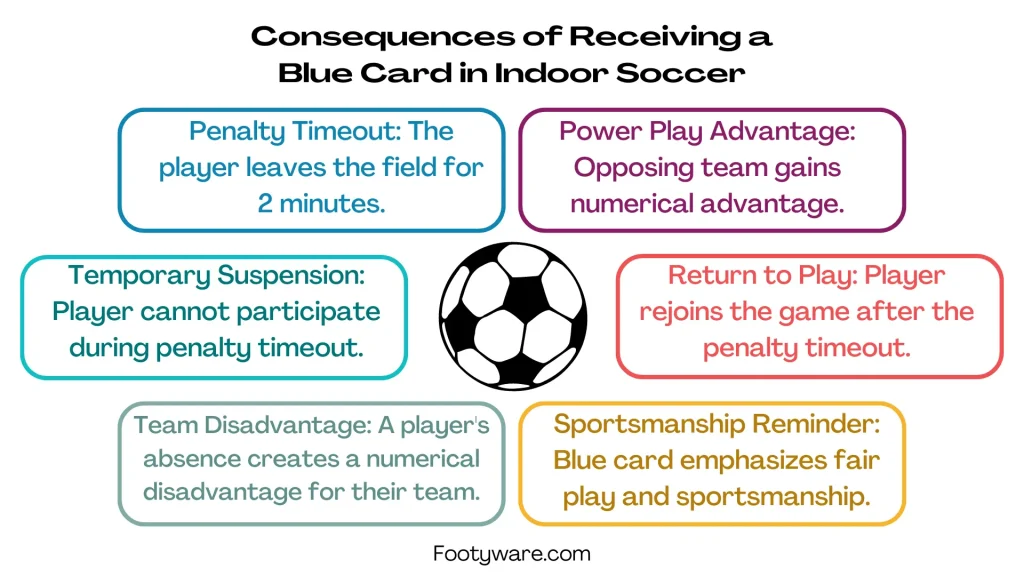
Receiving a blue card in indoor soccer entails specific consequences for the offending player and their team. When a player is issued a blue card, they are required to leave the playing area immediately for 2 minutes and sit in the penalty box. This designated area serves as the temporary suspension zone for penalized players.
During the player’s penalty timeout, their team plays with a numerical disadvantage, and the opposing team gains a power play advantage. Once the penalty timeout expires, the penalized player is invited back onto the field to resume participating in the game, but they must adhere to the rules and avoid any further offenses.
Here’s a quote from a reputable news outlet to this effect:
Source: Tampa Bay Times“The blue card is a third penalty card referees have been carrying this season in addition to the yellow and red. According to the FHSAA soccer manual, there is only one instance a blue card should be used: when a player uses his or her hands to prevent a goal-scoring opportunity. The offense was previously issued a red card, which resulted in the player being ejected and suspended for up to a week (two games). The team could not substitute for that player. With the blue card, the penalty is less severe. The player is disqualified from the game but is not subject to a suspension. The team is still not allowed to substitute.”
How Blue Cards Affect Game Strategy
The blue card creates unique tactical situations not found in outdoor soccer.
Power Play Situations
For the Team with Advantage (5v4):
Offensive Strategies:
- Overload one side of field
- Quick ball movement to tire defenders
- Take more shots (opponents can’t pressure as much)
- Utilize extra player in key attacking positions
- Draw defenders out of position
Key Principle: Maximize the 2-minute window to score and end penalty early.
For the Short-Handed Team (4v5):
Defensive Strategies:
- Compact defensive shape
- Protect goal area priorit
- Clear balls quickly (don’t possess)
- Run down clock
- Communicate constantly
- Goalkeeper plays more actively
Key Principle: Survive the 2 minutes without conceding. If opponent scores, penalty ends anyway.
Coaching Tactical Decisions
When to Take a Blue Card Strategically:
- Late in game protecting lead (waste time)
- Stopping dangerous counterattack (tactical foul)
- Frustrating opponent’s rhythm
Warning: Taking intentional blue cards is unsportsmanlike and may result in harsher penalties if referee recognizes the intent.
Managing Players with Blue Cards:
- Track which players have blue cards
- Substitute players approaching multiple blues
- Adjust tactics if key player in penalty box
- Prepare power play units in practice
Blue Cards in Different Indoor Soccer Formats
6v6 Indoor Soccer (Most Common)
Standard Format:
- 6 players per team (including goalkeeper)
- Blue card = team plays 5v6
- Significant disadvantage
- Common in adult leagues
Blue Card Impact: More pronounced in smaller formats where each player matters more.
5v5 Indoor Soccer/Futsal
Important Distinction:
- Indoor soccer (5v5): May use blue cards depending on league
- fFutsal: Does NOT use blue cards (FIFA rules, only yellow/red)
When 5v5 Indoor Uses Blues:
- Team plays 4v5 during penalty
- Even more significant disadvantage
- Power plays more dangerous
7v7 or 8v8 Indoor Soccer
Larger Formats:
- Blue card impact slightly less severe
- More players to cover gaps
- Still creates advantage
Referee Discretion and Blue Card Guidelines
Referees have significant discretion in issuing blue cards, but follow general guidelines.
When Referees Show Blue Instead of Yellow
Blue Card Preferred For:
- First offense of minor nature
- Technical violations without malice
- Honest mistakes vs. intentional fouls
- Player shows immediate remorse
- Offense doesn’t endanger opponent
Example: Player accidentally has too many players on field (illegal sub) = Blue card. Same player argues extensively = Yellow card.
Referee Training on Blue Cards
Key Considerations:
- Consistency: Apply same standard throughout game
- Game management: Use blues to prevent escalation
- Communication: Explain briefly why blue card issued
- Control: Don’t hesitate to upgrade to yellow if needed
Philosophy: Blue cards allow referees to penalize without escalating unnecessarily, keeping games under control while players on field.
Player Appeals and Arguments
Cannot Be Changed:
- Blue card decisions are final
- Arguing risks additional card (yellow for dissent)
- Accept penalty and serve time
After-Game Review:
- Some leagues allow post-game appeals
- Must follow league procedures
- Rarely overturned
- Focus should be on future compliance
Blue Cards for Different Age Groups
Blue card implementation varies significantly by age and competition level.
Youth Indoor Soccer (Under 12)
Modified Blue Card Use:
- Often used as teaching tool
- May result in shorter penalties (1 minute)
- Emphasis on education over punishment
- Coaches often explain to player during penalty
- Less strict accumulation rules
Philosophy: Teach young players consequences while keeping them engaged.
Teen/High School (Ages 12-18)
Standard Blue Card Application:
- Full 2-minute penalties
- Track accumulation more strictly
- Prepares players for adult leagues
- Coaches use as learning opportunities
- May affect playing time
Adult Recreational Leagues
Casual Enforcement:
- Blue cards used for game control
- Less strict accumulation tracking
- Emphasis on keeping games friendly
- May be more lenient on first offenses
Adult Competitive/Professional
Strict Application:
- Blue cards issued consistently
- Accumulation tracked meticulously
- Suspensions enforced for multiple blues
- Players expected to know rules
- No leniency for ignorance
Common Blue Card Scenarios and Examples
Scenario 1: Illegal Substitution
Situation: Team A has 6 players on the field when the limit is 5 (not counting goalkeeper).
Referee Action:
- Stops play immediately
- Issues blue card to the extra player (or player who should have left)
- Player serves 2-minute penalty
- Team A plays 4v5 (in 5v5 format)
Prevention: Ensure proper communication during substitutions, use designated sub zones.
Scenario 2: Delay of Game
Situation: Goalkeeper holds ball for 8 seconds when the limit is 5 seconds.
Referee Action:
- Blows whistle for violation
- Shows blue card to goalkeeper
- Goalkeeper serves 2 minutes in penalty box
- Substitute goalkeeper enters (if available) or field player plays goal
Prevention: Goalkeepers should distribute quickly and stay aware of time limits.
Scenario 3: Dissent
Situation: Player disagrees with foul call and sarcastically claps at referee.
Referee Action:
- Immediately shows blue card for dissent
- Player serves 2-minute penalty
- Further argument could escalate to yellow or red
Prevention: Accept referee decisions without commentary or gestures.
Scenario 4: Encroachment on Free Kick
Situation: Defending player stands 2 feet from ball during opponent’s free kick (required distance is 10 feet).
Referee Action:
- Blue card for encroachment
- Free kick retaken
- Player serves penalty
Prevention: Respect required distance from all restarts.
Scenario 5: Accumulation – 3rd Blue Card
Situation: Player receives their 3rd blue card in the same game.
Referee Action:
- Shows blue card followed immediately by red card
- Player ejected from game
- Cannot return
- Team short-handed for 5 minutes (then can substitute in most leagues)
- Player may face additional suspension for next game
Prevention: Players with 2 blues should play conservatively to avoid third.
Are Blue Cards Used in All Indoor Soccer?
Short Answer: No, blue card use varies significantly by league, region, and facility.
Leagues That Use Blue Cards
Professional/Semi-Professional:
- Major Arena Soccer League (MASL) – North America
- Professional Arena Soccer League (PASL) – North America
- Various regional professional indoor leagues
Recreational:
- Many indoor soccer facilities in USA and Canada
- Varies by facility house rules
- Some use, some don’t
Youth:
- Depends on organizing body
- Many youth leagues use modified versions
- Educational emphasis
Leagues That DON’T Use Blue Cards
Futsal (FIFA Rules):
- NO blue cards in futsal
- Only yellow and red cards
- Different penalty system (accumulated fouls)
- Confused with indoor soccer but distinct sport
Some Recreational Leagues:
- Smaller facilities may not use penalty box system
- Simplified rules for casual play
- May use only yellow/red cards
Outdoor Soccer:
- Never uses blue cards
- Standard yellow and red only
- FIFA regulations prohibit blue cards
How to Know if Your League Uses Blue Cards
Check:
- League rulebook or website
- Pre-season coaches meeting
- Ask facility staff
- Observe other games
- Ask referee before your game
Conclusion: Understanding the Blue Card System
The blue card represents indoor soccer’s innovative approach to maintaining discipline while keeping players on the field and games exciting. Unlike outdoor soccer’s yellow and red card system, the blue card creates temporary power play situations that add strategic depth to indoor soccer.
Key Takeaways:
✓ Blue cards = 2-minute penalties for minor offenses in indoor soccer ✓ Team plays short-handed until penalty expires or opponent scores ✓ Common offenses: illegal substitution, delay of game, dissent, encroachment ✓ Accumulation matters: 3 blue cards typically = ejection ✓ NOT used in futsal – only in indoor soccer ✓ Varies by league – always check your specific league rules ✓ Strategic impact: creates power play opportunities like hockey ✓ Referee discretion determines when blues vs yellows are appropriate
Understanding blue card rules helps players avoid unnecessary penalties, coaches develop strategies for power play situations, and fans appreciate the tactical nuances of indoor soccer. The blue card system keeps the game flowing while maintaining discipline—a balance that serves the fast-paced, high-intensity nature of indoor soccer.
Whether you’re a player trying to avoid penalties, a coach strategizing power plays, or a fan learning the game, knowing blue card rules enhances your indoor soccer experience. Play smart, respect the rules, and enjoy the unique excitement that indoor soccer’s three-card system brings to the beautiful game.