
Is There Offside in Indoor Soccer? Complete Rules Guide
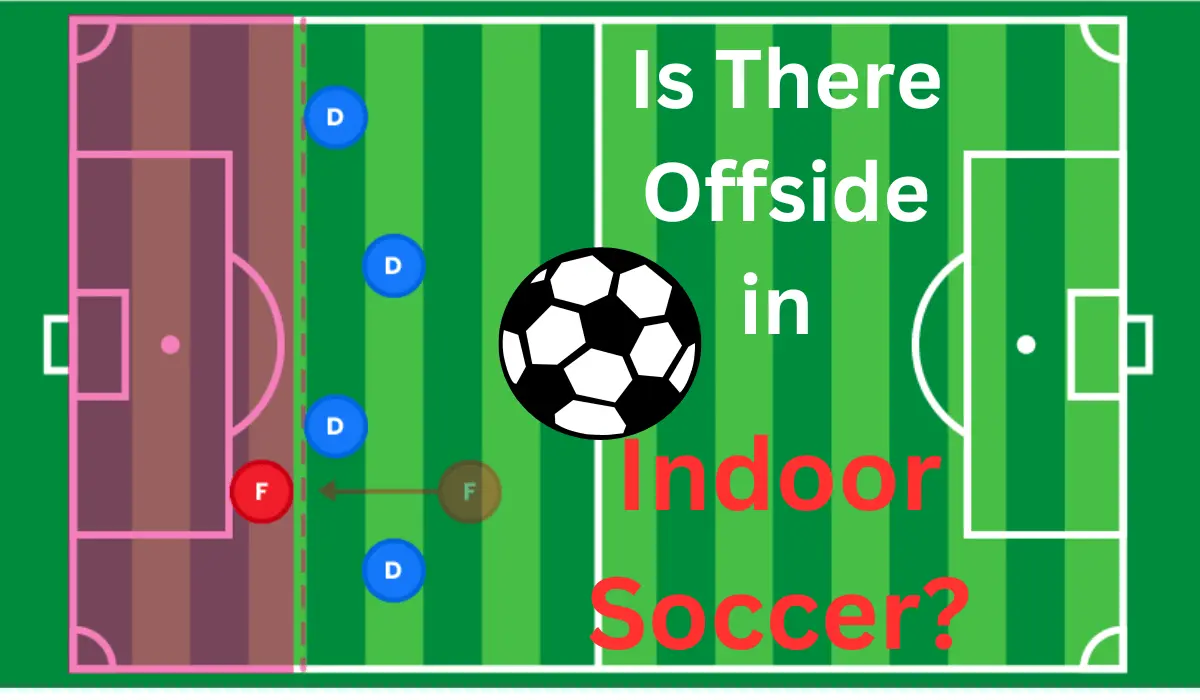
Quick Answer: No, there is no offside rule in indoor soccer. Players can position themselves anywhere on the field, including directly in front of the opponent’s goal, without being called offside. However, the three-line violation rule prevents long aerial passes across the entire field.
Offside Rule in Indoor Soccer
Understanding the Offside Rule in Indoor Soccer
The absence of the offside rule is one of indoor soccer’s most distinctive features, fundamentally changing how the game is played compared to outdoor soccer.
Why Indoor Soccer Has No Offside
Historical Reasons:
- Indoor soccer evolved to maximize action and scoring
- Smaller field size makes traditional offside impractical
- Continuous play (walls keep ball in) reduces natural breaks
- Entertainment value prioritized constant attacking opportunities
Practical Impact:
- Attackers can position anywhere without restriction
- “Cherry picking” (staying near opponent’s goal) is allowed
- Defenders must maintain tighter marking
- Creates faster-paced, higher-scoring games
- Eliminates offside trap as a defensive tactic
What This Means for Players
For Attackers: ✓ Freedom to position deep in attacking third ✓ Can stay high and wait for long passes ✓ No worry about timing runs ✓ More scoring opportunities ✓ Forces defenders to mark tightlyFor Defenders: ✗ Must track attackers everywhere ✗ Cannot rely on offside trap ✗ Need constant awareness of opponent positions ✗ Requires better communication and organization ✗ More vulnerable to counterattacks
There are also players called thief players mostly adult indoor soccer players who’ll just hide during the whole game and then you’ll see them in front of the goal with the ball on their feet and nobody will be covering them so it is better to keep an eye on those players before the ball is passed to them.
The Three-Line Violation Rule Explained
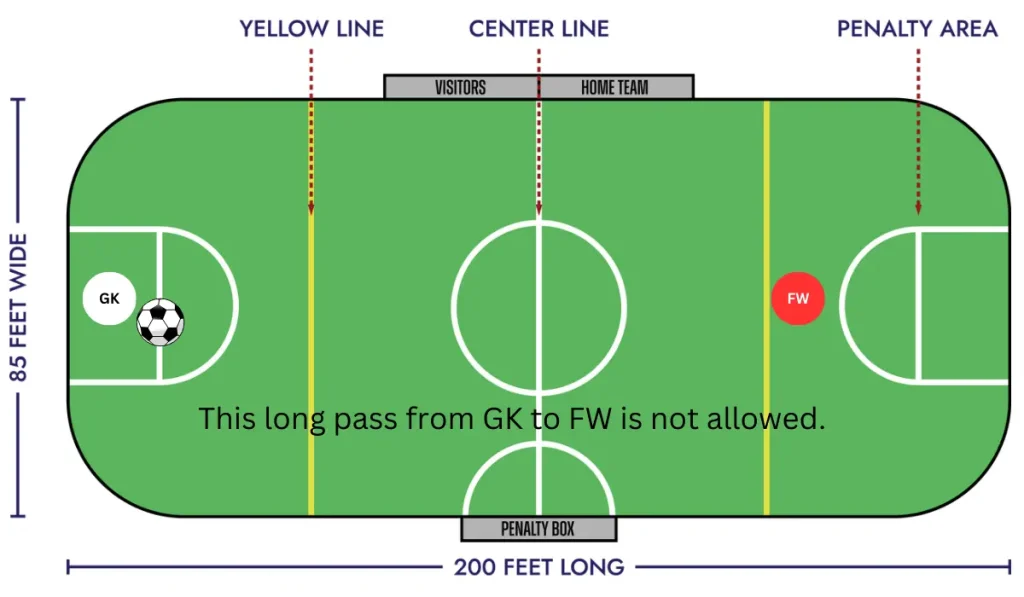
While there’s no offside, indoor soccer uses the three-line violation rule to prevent excessive long-ball tactics.
What is the Three-Line Violation?
Rule Definition: A three-line violation occurs when a player makes an aerial pass (ball doesn’t touch the ground) from behind their own penalty area that crosses all three lines on the field and lands in the opponent’s penalty area.
The Three Lines:
- Attacking team’s penalty area line (where pass originates from behind)
- Halfway/center line
- Defending team’s penalty area line (where ball lands)
Violation Criteria:
- Pass must be aerial (ball in the air throughout)
- Must originate from behind the penalty area line
- Must cross all three lines without touching the ground
- Must land in or beyond opponent’s penalty area
Penalty for Violation:
- Indirect free kick awarded to opposing team
- Taken from where the ball first crossed the penalty area line
- Play stops immediately when violation occurs
Why This Rule Exists
Purpose:
- Prevents “kick and chase” long-ball tactics
- Encourages skillful buildup play
- Maintains focus on passing and dribbling
- Reduces aerial bombardment of the goal
- Keeps the game ground-based and technical
What’s Still Allowed: ✓ Long passes that bounce before crossing all three lines ✓ Long passes from in front of your penalty area ✓ Long passes that don’t reach opponent’s penalty area ✓ Aerial passes along the ground (contradictory but refers to trajectory) ✓ Wall passes or rebounds that travel the length of the field
Tactical Impact
For Offense:
- Must build attacks through midfield
- Encourages short, quick passing combinations
- Promotes dribbling and individual skill
- Creates more possession-based play
- Rewards technical ability over physical strength
For Defense:
- Can position higher up the field
- Reduces pressure from constant aerial attacks
- Allows more organized defensive shape
- Less risk of being caught by surprise long balls
Complete Indoor Soccer Rules Beyond Offside
1. Unlimited Substitutions
How It Works:
- Substitutions made “on the fly” during active play
- Players enter and exit through designated substitution area
- No need to wait for stoppage in play
- Unlimited number of substitutions allowed
- Similar to hockey-style line changes
Strategic Implications:
- Keeps players fresh throughout the game
- Allows frequent rest for high-intensity efforts
- Enables tactical changes mid-play
- Rewards teams with deeper benches
- Maintains constant high pace
Substitution Rules:
- Player leaving must exit the field completely before replacement enters
- Both must use the substitution zone (usually at midfield)
- Illegal substitution = 2-minute penalty (blue card)
- Goalkeepers can be substituted like field players
2. Five Accumulated Fouls Rule
How It Works:
- Team fouls reset at halftime
- Each team gets 5 “free” fouls per half
- Starting with the 6th team foul, opponent receives a direct free kick
- Free kick taken from the second penalty mark (typically 10 meters from goal)
- No defensive wall allowed on 6th+ fouls
What Counts as a Foul:
- Both direct and indirect free kick fouls accumulate
- Includes pushing, holding, tripping, handball, etc.
- Yellow cards typically add to foul count
- Goalkeeper fouls count toward team total
Strategic Considerations:
- Teams must be disciplined in the second half of each period
- Aggressive teams risk giving up penalty-like free kicks
- Smart teams track foul count and adjust tactics
- Can intentionally foul early if needed strategically
Foul Tracking:
- Referee tracks using scoreboards or hand signals
- Announced when teams reach 5 fouls
- Resets to zero at halftime
3. Penalty Kicks
When Awarded:
- Foul committed inside the penalty area
- Handball in the box
- Denying obvious goal-scoring opportunity in box
- Goalkeeper violations inside penalty area
Penalty Kick Procedure:
- Taken from penalty mark (6 meters from goal typically)
- All players except kicker and goalkeeper behind halfway line
- Goalkeeper must stay on goal line until kick is taken
- Kicker cannot touch ball twice (no follow-up on rebounds)
Key Differences from Outdoor Soccer:
- Shorter distance (6m vs 11m/12 yards)
- All players behind halfway line (not just outside box)
- More difficult for goalkeeper due to closer range
4. Card System
Indoor soccer uses a three-card system: Blue, Yellow, and Red.
Blue Card (2-Minute Penalty):
- Minor fouls and misconduct
- Illegal substitution
- Player sits out for 2 minutes (time penalty)
- Team plays short-handed during penalty
- Similar to hockey penalty box
- Player can return after 2 minutes or if opponent scores
Yellow Card (5-Minute Penalty or Ejection):
- Serious foul play
- Persistent infringement
- Dissent toward referee
- Unsporting behavior
- Player ejected for 5 minutes
- Can be replaced after 5 minutes
Red Card (Ejection + Suspension):
- Violent conduct
- Serious foul or dangerous play
- Second yellow card in same game
- Using offensive language/gestures
- Player ejected for remainder of game
- Team plays short-handed for 2-5 minutes (varies by league)
- Player typically suspended for next game
Accumulation Rules:
- Some leagues: 5 blue cards = automatic yellow
- Yellow cards may accumulate across games for suspension
- Red card = automatic multi-game suspension
5. Kick-Ins (Instead of Throw-Ins)
How It Works:
- When ball crosses sideline (touchline), it’s kicked back in
- Ball placed on the line where it exited
- Must be kicked (not thrown) back into play
- All opponents must be at least 3 feet/1 meter away
Rules:
- Cannot score directly from a kick-in
- Kicker cannot touch ball again until another player touches it
- Ball must be stationary before kick
- Both feet can be on or off the ground
Advantage Over Throw-Ins:
- Maintains ground-based play
- Allows for quicker restarts
- Keeps ball low and under control
- More tactical options than throw-ins
6. Goal Kicks
When Awarded:
- Ball crosses goal line (not in goal) after last being touched by attacking team
- Similar to outdoor soccer
How Taken:
- Goalkeeper may throw or kick from inside penalty area
- Many leagues allow goalkeeper to throw for quicker distribution
- All opponents must be outside penalty area
- Cannot score directly from opponent’s goal kick
7. Corner Kicks
When Awarded:
- Ball crosses goal line (not in goal) after last being touched by defending team
How Taken:
- Ball placed in corner arc
- Kicked into play by attacking team
- Opponents must be at least 3 feet/1 meter away
- Can score directly from corner kick
8. Slide Tackling Rules
General Rule: Most indoor soccer leagues prohibit or heavily restrict slide tackles for safety reasons.
When Allowed:
- Some leagues allow slide tackles if:
- Ball is won cleanly without contact
- No endangerment to opponent
- Executed with control
When Prohibited:
- Sliding from behind (automatic red card in most leagues)
- Contact with opponent before ball
- Dangerous or reckless sliding
- Goalkeeper sliding outside their penalty area (in some leagues)
Exception:
- Goalkeepers typically allowed to slide within their penalty area
Penalty:
- Yellow or red card depending on severity
- Direct free kick if foul
- Adds to team accumulated fouls
9. Time Rules
Game Duration:
- Typically two 20-30 minute halves (varies by league)
- Running clock or stop clock (depends on league)
- Halftime break: 5-10 minutes
Timeouts:
- Most leagues allow 1 timeout per team per half
- 1 minute duration
- Can only be called during stoppage in play or when team has possession
Indoor Soccer vs. Outdoor Soccer: Complete Comparison
Indoor Soccer vs. Outdoor Soccer: Complete Comparison
| Feature | Indoor Soccer | Outdoor Soccer |
|---|---|---|
| Offside Rule | No offside | Offside enforced |
| Field Surface | Artificial turf or sport court | Natural or artificial grass |
| Field Size | 180-200′ x 80-90′ (smaller) | 330′ x 225′ (full size) |
| Boundaries | Walls keep ball in play | Lines mark out of bounds |
| Team Size | 6 vs 6 (including GK) | 11 vs 11 (including GK) |
| Substitutions | Unlimited, on-the-fly | Limited (3-5), during stoppages |
| Game Length | 40-60 minutes total | 90 minutes total |
| Ball Restarts | Kick-ins | Throw-ins |
| Accumulated Fouls | 5 fouls = direct free kicks | No accumulation system |
| Card System | Blue, Yellow, Red | Yellow, Red |
| Slide Tackles | Prohibited or restricted | Allowed if safe |
| Goal Size | Smaller (12′ x 6′ typical) | Regulation (24′ x 8′) |
| Footwear | Turf shoes or flat-soled | Cleats with studs |
| Pace | Fast, continuous | Varied, with stoppages |
| Playing Style | Quick passes, individual skill | More tactical, team shape |
| Three-Line Rule | Yes | No |
Indoor soccer games are just 60 minutes long with unlimited rolling substitutions, leading to almost non-stop end-to-end action.
Players wear the best shoes for indoor soccer having flat non-marking rubber outsole instead of cleats and kick the ball in rather than throw it when it goes out of the sidelines.
The no-offside rule allows attackers to freely roam into scoring areas in front of the opposite goal and to position themselves in scoring range means in the D area or adjacent to the D area. A unique indoor soccer blue card is used in indoor soccer to indicate a 2-minute penalty for small fouls.
The tighter spaces, faster pace, and increased reliance on individual ball skills give indoor soccer its feel compared to the outdoor game which relies more on team shape, set plays, and tactical formations.
While both versions share common elements, the variations in field, rules, and gameplay make indoor soccer an entirely different experience from its outdoor counterpart.
Key Playing Differences
Indoor Soccer Characteristics:
- Faster pace with constant action
- More touches per player
- Emphasis on close control and quick passing
- Walls used strategically
- Higher scoring games
- Less emphasis on physicality
- Individual skill showcased
Outdoor Soccer Characteristics:
- More strategic with slower buildup
- Greater emphasis on team tactics
- Offside creates defensive organization
- More aerial play
- Physical challenges more common
- Set pieces (corners, free kicks) more important
- Endurance over speed
Player Positions and Formations in Indoor Soccer
One key difference between indoor and outdoor soccer is the positions and formations used due to having fewer players on the field. It’s normal to switch to unique indoor soccer positions and indoor soccer formations that develop in fast-paced games with no offside rule.
Common 6v6 Indoor Soccer Formations
2-2-1 Formation (Balanced)
Setup:
- 2 Defenders
- 2 Midfielders
- 1 Striker
Strengths: ✓ Balanced between attack and defense ✓ Good coverage across the field ✓ Solid defensive foundation ✓ Two midfielders control possession
Best For: Teams wanting equilibrium, beginners, evenly matched games
2-1-2 Formation (Attacking)
Setup:
- 2 Defenders
- 1 Midfielder
- 2 Strikers
Strengths: ✓ Double attacking threat ✓ Constant pressure on defense ✓ Exploits no-offside rule with high positioning
Best For: Offensive teams, when chasing a goal, against weaker defenses
1-3-1 Formation (Possession)
Setup:
- 1 Defender
- 3 Midfielders
- 1 Striker
Strengths: ✓ Dominates midfield ✓ Controls possession ✓ Multiple passing options
Best For: Technical teams, controlling game tempo, skilled passers
3-1-1 Formation (Defensive)
Setup:
- 3 Defenders
- 1 Midfielder
- 1 Striker
Strengths: ✓ Maximum defensive coverage ✓ Solid for protecting leads ✓ Difficult to break downBest For: Protecting a lead, facing superior attackers, counterattacking strategy
Position Roles Without Offside
Defenders:
- Must be prepared for attackers camping near goal
- Cannot rely on offside trap
- Must mark attackers tightly everywhere
- Track runners into dangerous areas
- Constant communication essential
- Quick recovery when beaten
Offensive Positions
Strikers in indoor soccer can position themselves more freely near the goal without worrying about being offside. Their focus is on making runs and scoring the goal, finding spaces to receive passes, and finishing scoring chances. Forwards must also be the first line of defense, pressing opponents.
Midfield Positions
Indoor soccer midfielders have a hugely important transition role going both ways between attack and defense. They need excellent close control and passing skills to retain possession in tight spaces. The midfielder must be very creative and confident on the ball so that he can deliver the best.
- Critical transition role both ways
- Excellent close control in tight spaces
- Quick decision-making required
- Support both attack and defense
- Most touches in game typically
- Must cover large areas
Interchanging Positions
There is greater fluidity in indoor soccer positions with players covering for each other. Attackers may have to defend and vice versa depending on match situations.
Adaptable Positions
The key is adapting positions and formations to your team’s strengths and weaknesses accordingly. With no offside rule, attackers have more freedom but defenders must be organized in a compact formation.
Having the tactical awareness and ability to play multiple positions allows your team to react to the fast-changing dynamics of indoor soccer driven by the no-offside rule and relentless end-to-end action with no room for mistakes because the intensity is very high a single mistake can cost in the form of a goal.
Forwards/Strikers:
- Can position freely near goal (no offside)
- Focus on finishing and creating space
- Press defenders when out of possession
- Make runs without timing concerns
- Hold up play to bring teammates in
- “Cherry picking” is viable tactic
Goalkeeper:
- More involved in distribution
- Quick decision-making for fast breaks
- Can throw ball to start attacks
- Must be vocal directing defense
- Shot-stopping from close range
- Smaller goal makes positioning critical
Essential Skills for Indoor Soccer
Technical Skills
Close Ball Control:
- Keep possession in tight spaces
- Use all parts of feet
- Shield ball from defenders
- Quick touches in confined areas
- Essential given smaller field
Ball Manipulation:
- Feints and stepovers
- Drag backs and step-overs
- Quick changes of direction
- Beating defenders 1v1
- Creativity in small spaces
Passing Accuracy:
- Precise distribution in tight areas
- One-touch passing combinations
- Wall passes using the boards
- Quick release under pressure
- Vision to find open teammates
Shooting Technique:
- Accuracy over power (smaller goals)
- Quick release
- Shooting from tight angles
- Finishing in crowded areas
- Low, placed shots
Physical Skills
Agility:
- Quick direction changes
- Explosive movements
- Low center of gravity
- Balance when challenged
- React to fast-changing situations
Speed and Quickness:
- Short burst acceleration
- Quick feet for dribbling
- Reaction speed
- Recovery speed on defense
Endurance:
- Maintain high intensity throughout
- Quick recovery between shifts
- Cardiovascular fitness
- Handle unlimited substitutions pace
Tactical Skills
Defensive Awareness:
- Mark without offside trap
- Track attackers everywhere
- Communicate constantly
- Cover teammates
- Anticipate passes
Offensive Movement:
- Create space for teammates
- Time runs effectively
- Use walls strategically
- Find pockets of space
- Exploit no-offside freedom
Communication:
- Constant verbal coordination
- Call for passes
- Direct teammates
- Organize defense
- Adjust tactics during play
How No Offside Changes Indoor Soccer Strategy
Attacking Strategies
Cherry Picking:
- Leave a player high near opponent’s goal
- Quick long balls to waiting striker
- Forces defenders to always track back
- Risky but can create breakaways
Constant Pressure:
- Forwards can stay high without offside worry
- Press defenders aggressively
- Force turnovers in dangerous areas
- Immediate counterattack opportunities
Triangle Passing:
- Create passing options in tight spaces
- Quick one-touch combinations
- Use walls as extra player
- Move ball faster than defenders can react
Defensive Strategies
Man-to-Man Marking:
- Cannot use offside trap
- Must mark attackers tightly
- Follow runs everywhere on field
- Require excellent fitness and discipline
Compact Shape:
- Stay organized in tight formation
- Don’t let attackers get behind
- Protect central areas
- Quick recovery when beaten
Communication:
- Constant talking essential
- Call out unmarked attackers
- Switch marking assignments
- Organize defensive shape
Conclusion: Embracing Indoor Soccer Without Offside
The absence of the offside rule fundamentally transforms indoor soccer into a unique, fast-paced sport that emphasizes skill, creativity, and constant action over tactical positioning systems.
Key Takeaways:
✓ No offside rule allows complete attacking freedom and creates higher-scoring games ✓ Three-line violation prevents excessive long-ball tactics while maintaining ground-based play ✓ Tighter defensive marking required since attackers can position anywhere ✓ Faster pace with continuous action and unlimited substitutions ✓ Individual skill emphasized over tactical team shape ✓ Different formations needed compared to outdoor soccer ✓ Modified rules (accumulated fouls, kick-ins, card system) create distinct playing style
Understanding that indoor soccer has no offside opens up new tactical possibilities and playing styles. Attackers can exploit positional freedom, defenders must maintain constant awareness, and teams must adapt formations to succeed in this high-intensity environment.
Whether you’re transitioning from outdoor soccer or starting fresh with indoor, embrace the freedom of no offside while mastering the unique rules and skills that make indoor soccer an exhilarating alternative to the traditional game.
The beautiful game’s indoor evolution offers something outdoor soccer cannot: relentless end-to-end action where every player is constantly involved, creativity flourishes in tight spaces, and goals come from unexpected angles. Step onto the court, forget the offside trap, and experience soccer at its fastest and most skillful.